Visualizing "invisible" radiation to learn safer practice
Education & XR — Digital Transformation for Radiation Protection
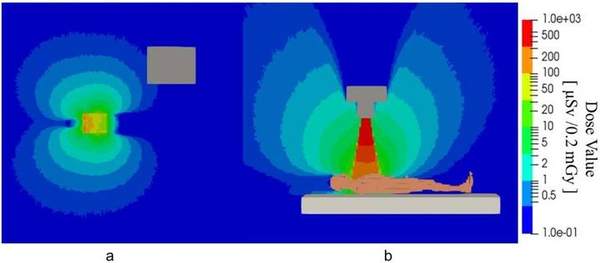
Because radiation is invisible, it is difficult to intuitively grasp the effect of protective actions. Using digital technologies such as AR/VR/MR (XR), our laboratory visualizes radiation scatter and dose distribution so that radiological staff can experientially learn "where to stand to reduce exposure." As clinical research on occupational diseases, we also verify the effectiveness of these materials.
The three principles of protection against external exposure turn the "optimisation" explained in Basics into everyday actions. They are different from the ICRP's three principles (justification, optimisation and dose limits) — please don't confuse the two.
Keep X-ray exposure time to a minimum; dose increases in proportion to time.
Keep as far as possible from the source; do not put hands in the field (dose differs >10× inside vs. outside the field).
Place shields/protective gear between the scatter source and the worker; optimize QC, exposure conditions and collimation.
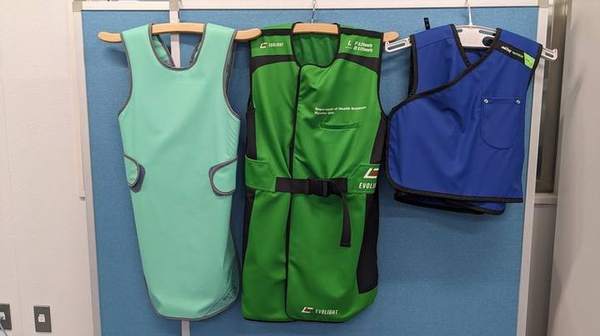
Protective equipment includes wearable types (aprons 0.25–0.35 mmPb, eyewear, thyroid shields, gloves) and non-wearable types (shielding plates, curtains, screens). We verify their effective placement with scatter simulation (for the actual state of eye-lens exposure, see Basics — survey of eye-lens exposure).
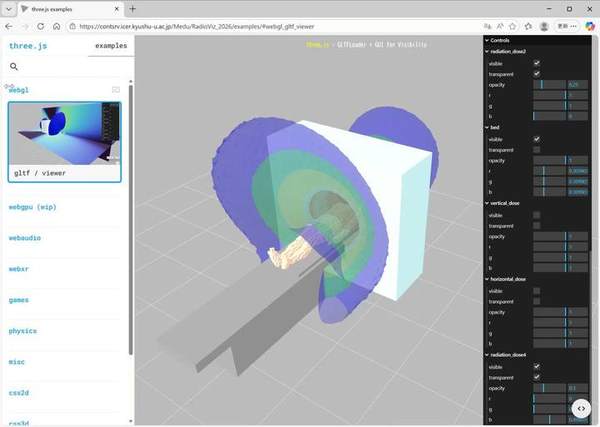
Spatially visualize scattered radiation and dose distribution with AR/VR/MR.
Organize dose-reduction actions by examination and department to support practice.
Radiation protection education in undergraduate and graduate programs.
Three pillars of the program
A site bundling text, images, videos, webVR materials and action checklists for interactive learning.
Simulation-based VR/AR visualizing scatter distribution; AR apps for cardiac cath, ERCP, CT and mobile C-arm.
Linked with wireless dosimeters and scatter-visualization cameras to estimate and warn of operator exposure in real time.
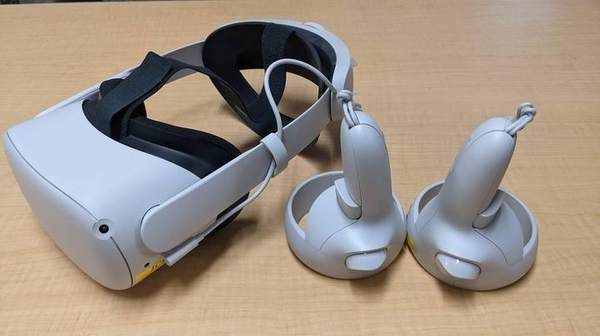
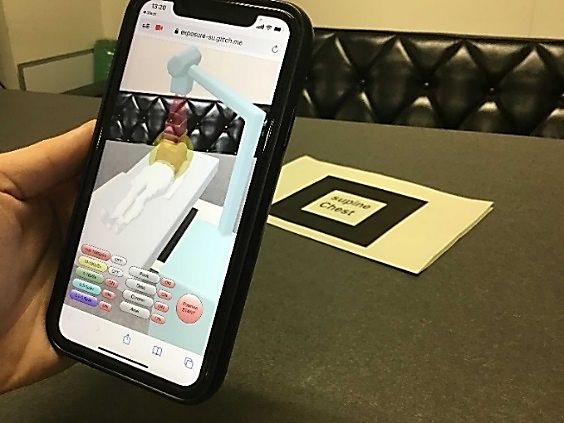
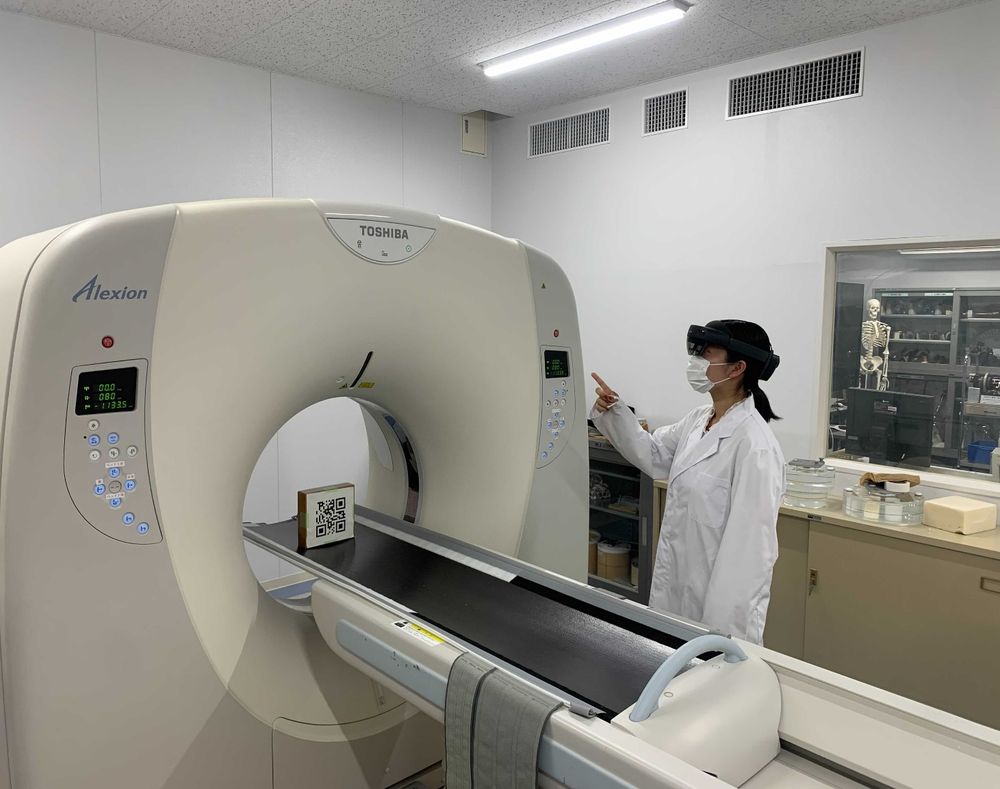
X-SERVE is an augmented-reality application developed in our laboratory that visualizes the distribution of scattered radiation in an X-ray fluoroscopy room. Viewed through a tablet or head-mounted display, the otherwise invisible spread of scatter is overlaid on the real room, letting staff see at a glance where standing position increases their exposure.
Conventional radiation-protection training relies on numbers and verbal explanation, which makes hazardous positions hard to grasp intuitively. By making scatter visible, X-SERVE allows physicians, nurses and radiologic technologists to choose protective behaviour for themselves. It is used alongside WebVR/AR learning materials and ParaView-based dose visualization, in both educational and clinical settings.
X-SERVE, the WebVR/AR materials and department-specific protective action checklists are published on our DX-based Radiation Protection Program for medical staff (DXRPP) site, an outcome of research funded by the Industrial Disease Clinical Research Grant.
Our scatter-visualization AR app "X-SERVE" (X-ray examination Scattered Radiation Visualize application) comes in three variants:
• X-SERVE: visualizes scatter in CT and similar exams in 2D/3D with distance and dose from the field center.
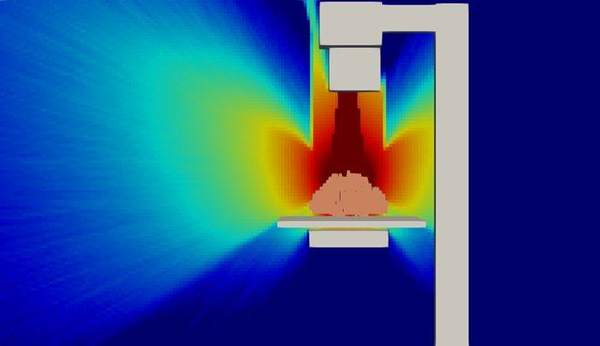
• X-SERVE IVR: for C-arm fluoroscopy; observe how the scatter distribution changes with angle and shield placement.
• X-SERVE VD (Volume Data): shows dose distribution on arbitrary cross-sections, staff dose and dose at the camera position, and compares cases with and without a protective curtain. Supports AR / 3D-viewer modes and body tracking.
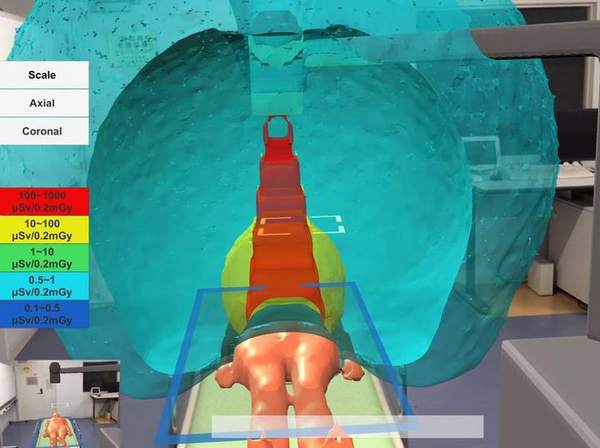
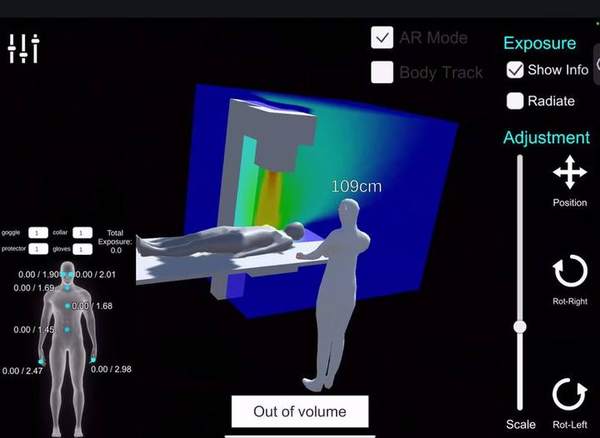
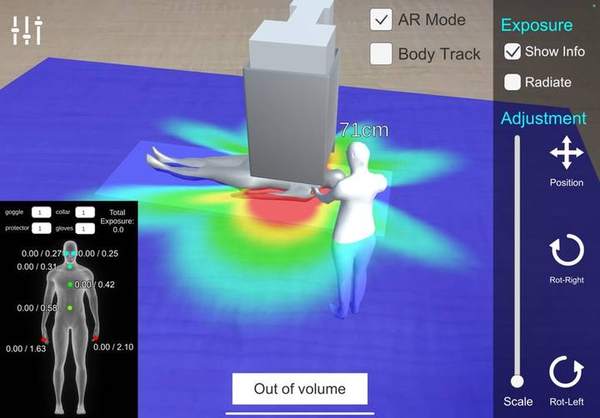
The AR app "X-SERVE" (X-ray examination Scattered Radiation Visualize application) overlays the Monte Carlo scatter distribution on real space on an iPad/iPhone, showing the 3D spread of scattered radiation in colors by dose level.
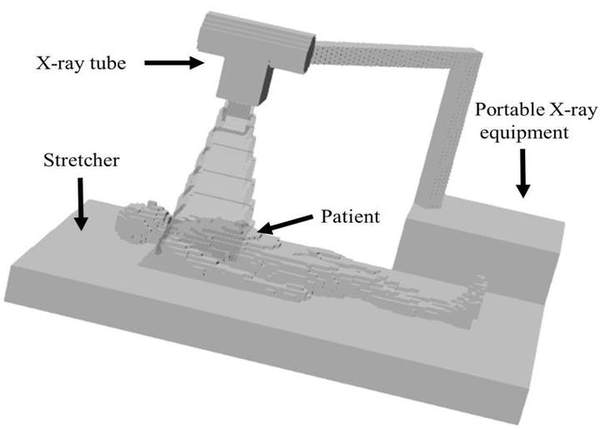
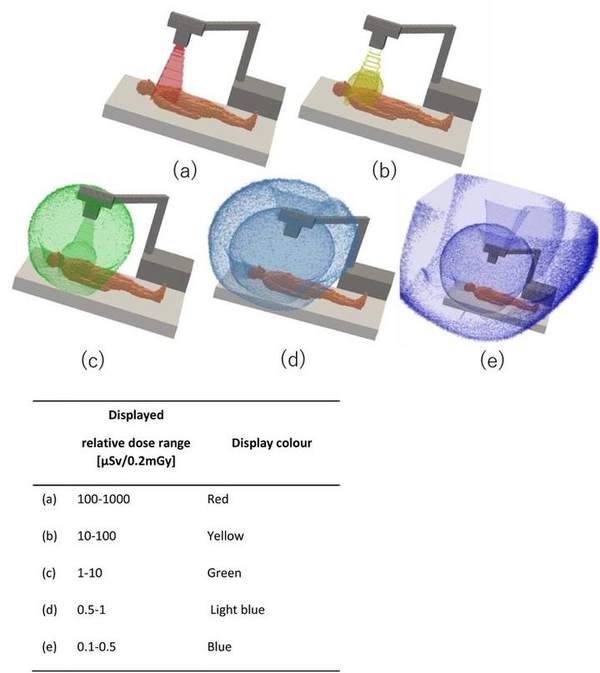
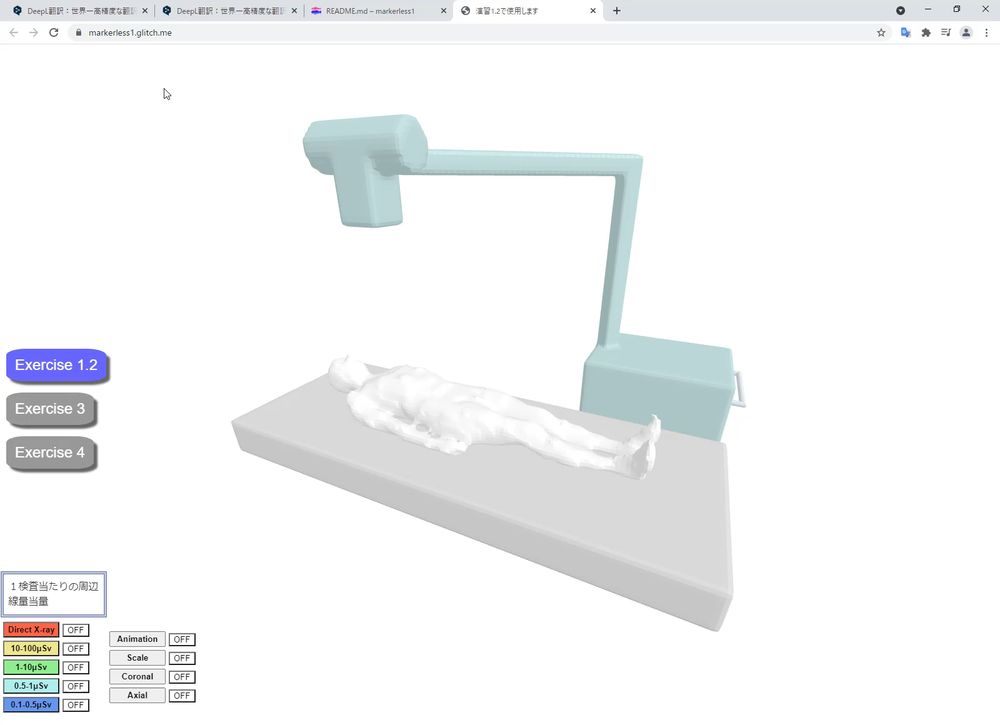
Try it in your browser. X-SERVE itself is an iPad/iPhone AR app, but the same scatter distributions can be explored in a browser. No installation required.
CT Room Scatter Viewer (WebXR) Scatter Map of an X-ray Room Radiation Dose Visualizer
Our other web materials are listed below in Web Materials You Can Use.
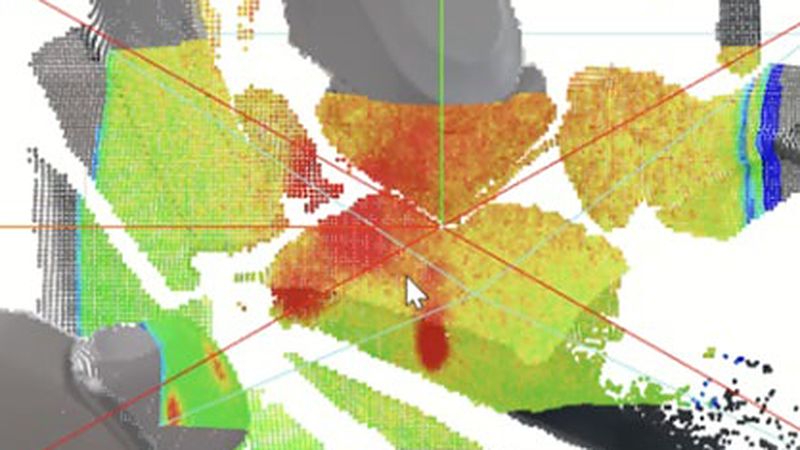
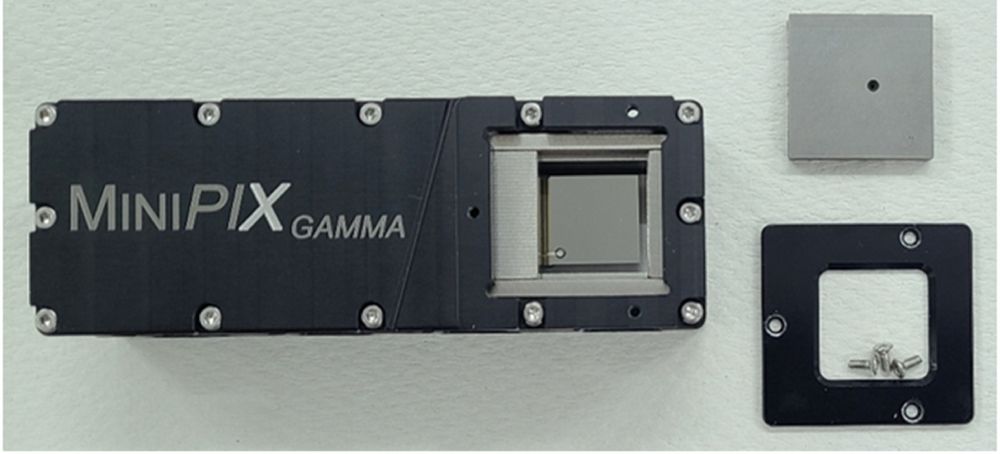
Besides showing calculated distributions, we also measure scattered radiation and turn where it comes from and how it spreads into images. Adding a depth camera to a visualization system that combines a pinhole collimator, a scintillator and a CMOS camera, we displayed the sources of scattered radiation in a cardiac angiography room in 3D. Scatter arises not only from the surface of the patient phantom on the X-ray entrance side but also from the table and the X-ray tube side. We also measure and visualize scattered X-rays with the compact Timepix3 semiconductor detector (MiniPIX, CdTe sensor). Measured distributions also back up the teaching materials that are based on calculation.
We don't stop at making materials: we measure their learning effect and improve them
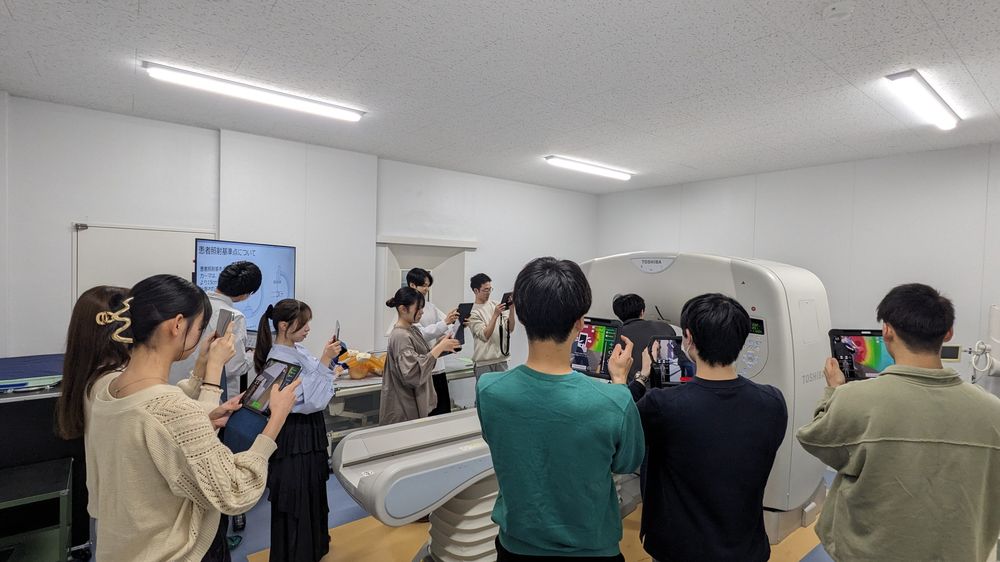
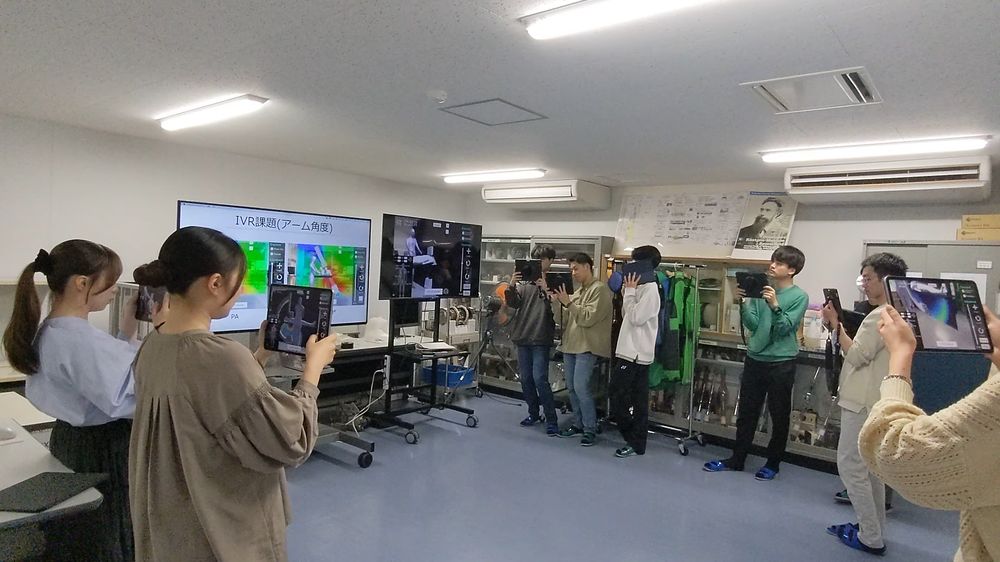
The materials we develop are built into actual lectures and practical training so that their effect can be verified. With 39 undergraduate students, we held AR practicals in an angiography room and a CT room and gave a 20-item true/false test before and after. Knowledge of where scatter comes from and how it spreads clearly improved, but how the distribution changes with C-arm angle remained difficult to understand, and having many functions or tasks increased cognitive load. We are making improvements, such as adding an introductory video and time for reflection.
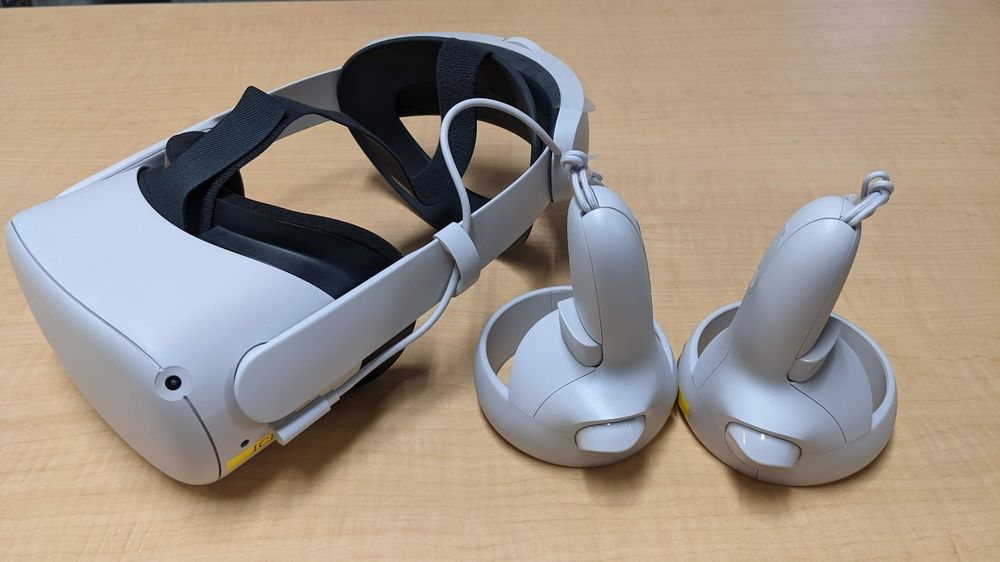
VR headsets are highly immersive but expensive and cannot be used by many people at once. We therefore developed WebXR materials that run in a web browser alone, so that anyone can access them from a PC or smartphone. Moving the device lets you view the scatter distribution from any direction, and the materials are also used in remote practicals for nursing students (Nishi, J. Radiol. Prot., 2022).
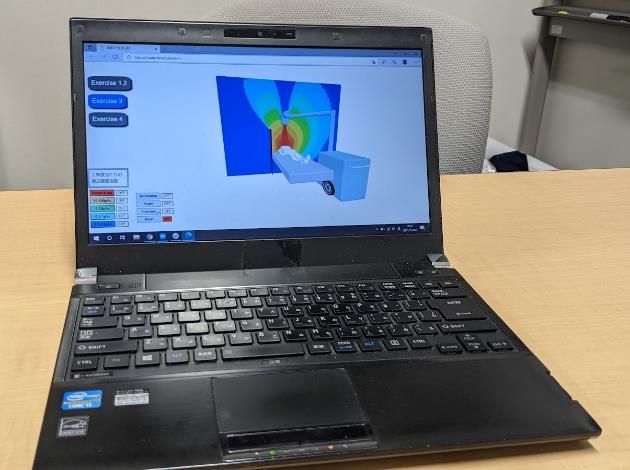
Try the WebXR material (Kyushu University ICER)
Demonstrations of scatter visualization and dose evaluation (from our YouTube channel "lab fujibuchi"). Click a thumbnail to play.
These are the materials introduced above that we make available to anyone. No installation is needed — they run in a web browser. Please use them for classes, training and self-study.
| Category | Name | What it does |
|---|---|---|
| ① Medical exposure | Entrance Surface Air Kerma Calculator | Estimates the patient's entrance surface dose from tube voltage, filtration and distance by Monte Carlo calculation (Birch–Marshall). |
| CT Patient Dose Distribution Calculator | Computes the 3D dose distribution inside the body during CT by Monte Carlo simulation and shows the dose to each organ. | |
| Dose Management System e-learning | Learn, by operating the screens, the cycle of recording, evaluating and optimising patient doses required under Japan's Medical Care Act. | |
| Radiotherapy Absorbed-Dose Calibration Trainer | Seven steps and 24 scenarios of water-phantom measurement, checking distances (SSD/SCD/SAD) and correction factors in 3D as you go. | |
| ② Occupational exposure | Scatter Map of an X-ray Room | Shows on a floor plan where, and how much, scattered radiation spreads in a radiography room — useful for deciding where to stand. |
| CT Room Scatter Viewer (WebXR) | Explore the 3D scatter distribution of a CT room in your browser — the web version of X-SERVE. | |
| Radiation Dose Visualizer | Change the exposure conditions and see interactively how the dose distribution in the room changes. | |
| RFMCEdu — X-ray Interactions and Monte Carlo Basics | Follow how photons interact and scatter, and see what goes on inside a Monte Carlo calculation. For basic learning. | |
| ③ Environment & education | Cs-137 Ground Contamination Dose Simulator | Calculates the dose distribution from contaminated ground; compare contribution rings, decontamination area, house shielding and penetration into the soil. |
| Radiation Risk Communication Training | Dialogue practice with an AI playing a member of the public or a patient. It scores you on empathy, scientific accuracy, clarity and support for decision-making, and suggests improvements. | |
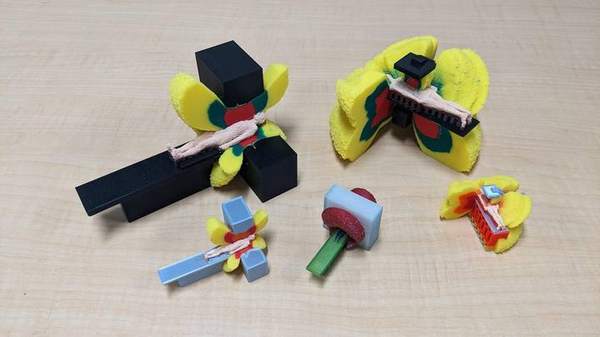
| AR Radiation Lesson for Elementary School Children | "Let's look inside the body with X-rays" — an AR lesson for children that also shows the X-rays bouncing off (scattered radiation). |
Some materials are restricted to the university network or are experimental. For questions about operating environments or problems, please contact us via Access & Contact.
The ICRP principles; medical, occupational and public exposure; and radiation protection culture — the ideas behind these materials.
The research behind the materials: scatter measurement and Monte Carlo simulation, X-SERVE and the eye-lens exposure survey.
Training and FD seminars for medical staff, joint development of teaching materials, and commissioned shielding and dose evaluation.
Please email us directly. We usually reply within a few working days.
Radiation protection training and FD seminars for medical staff.
Email about trainingDose evaluation, shielding calculation, scatter visualisation and XR materials.
Email about collaboration